


- Online Backgammon
- /
- Short backgammon
- /
- Rules


-
About
-
Nardy
-
Rating
-
Skill
-
Help
-
Nardy Rules
-
Backgammon Rules
-
Rules
-
Help - interface
-
Short backgammon rules of the game
Backgammon has remained popular for about five thousand years. No one knows the exact place and time of its origin, but many legends tell the story of how it emerged. Enthusiasts believe that the game develops strategic thinking, concentration, and the ability to calculate moves several steps ahead. This is why children begin learning its basic rules as early as five or six years old.
Backgammon lovers spend a great deal of time at the board, while frequent competitions, tournaments, and simply friendly games only fuel their interest. The official rules were approved in 1743, and world-class championships are held under them.
Rules of Short Backgammon
In Western countries, a version of the game known as short backgammon has become more widespread. It is a game for two opponents in which it is important not only to roll the dice successfully, but also to build points correctly, hit single checkers at the right time, and calculate future moves.
A game uses a board with 24 points, 30 checkers in two colors, and two dice. Each participant has 15 checkers. The board is conventionally divided into the home board, outer board, opponent's outer board, and opponent's home board. The central divider between the two halves of the board is called the bar.
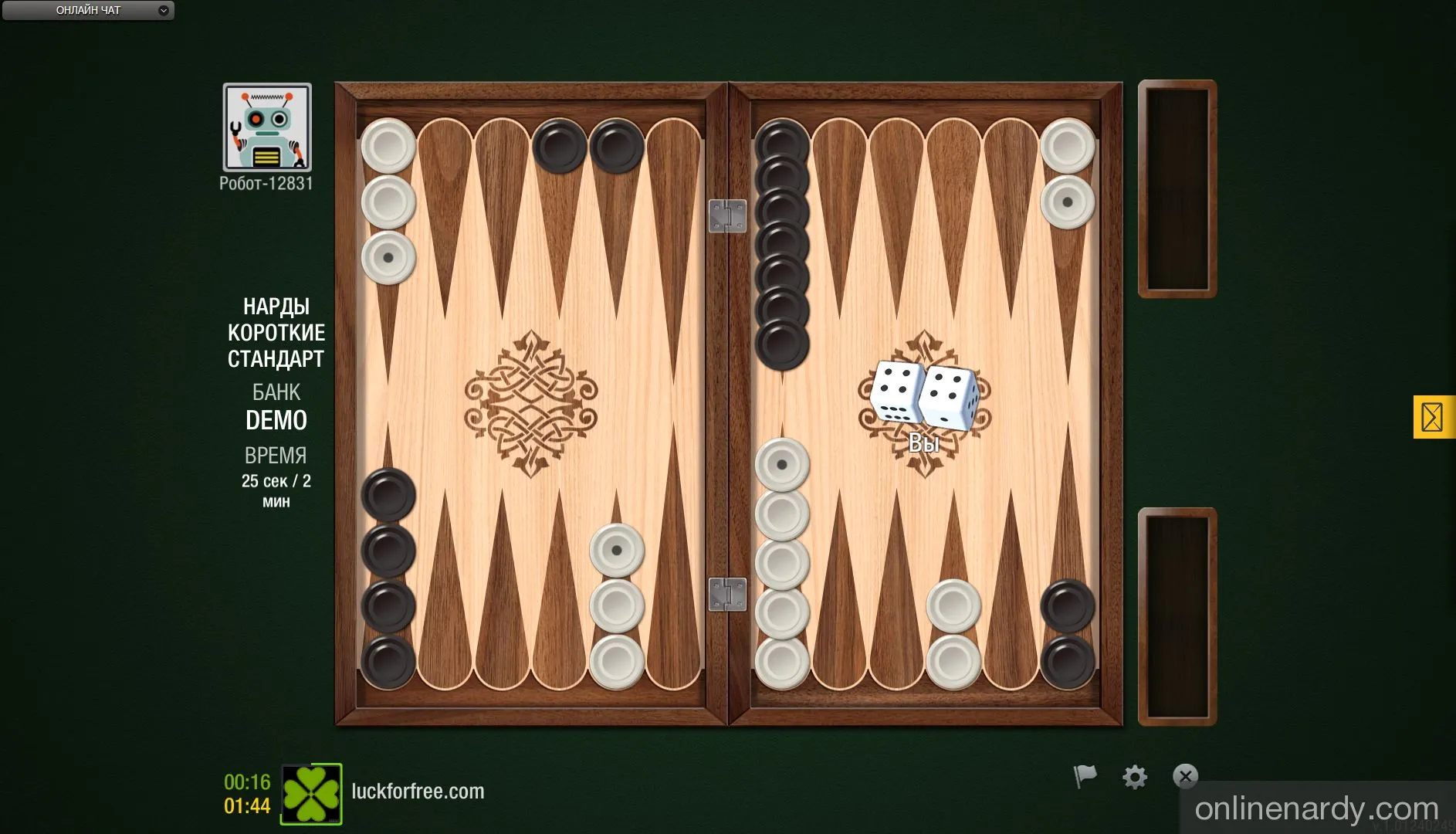
Starting Position and First Move
The starting position is the same for each player relative to their direction of movement: 2 checkers are placed on the 24th point, 5 on the 13th, 3 on the 8th, and 5 on the 6th. Opponents move toward each other, bring all their checkers around their route into their home board, and then bear them off the board.
In the first game of a series, the order of play is determined by each player rolling one die. If the values are equal, the roll is repeated. The player with the higher number starts the game and does not need to roll both dice again: the values of both dice rolled to determine the order are immediately used as their first move.
For subsequent games in a series, the website offers the "1st move in series" setting. With the "Loser" option, the player who lost the previous game receives the right to start the new one. With the "Alternating" option, opponents take turns starting games.
How Checkers Move
The numbers on the dice are played separately. For example, with 2 and 3, one checker may be moved 2 points and another 3 points, or both values may be played with one checker. In the latter case, the intermediate stop must be permitted in at least one valid order of playing the dice.
You may not land on a closed point occupied by two or more opposing checkers. A move may end on an empty point, a point occupied by your own checkers, or a point occupied by a single opposing checker. Such a single checker is called a blot; when landed on, it is hit and sent to the bar.
A double is played four times. Thus, a roll of 3:3 gives four separate moves of three points each.
A player must use both rolled values if the position rules allow it. If only one of the two numbers can be played, the possible value is used. When both numbers can be played separately but cannot be played together, the higher number must be played.
Hit Checkers and Entering from the Bar
As long as at least one of a player's checkers is on the bar, normal movement of the remaining checkers is prohibited: hit checkers must first be re-entered into the opponent's home board. The entry point is determined by the value of the die.
If both corresponding points are closed, no move can be made. If only one is closed, the player must enter using the other value if such an entry is permitted. After a checker returns from the bar, the remaining die must also be played when a valid move exists; it is forfeited only when there is no legal continuation.
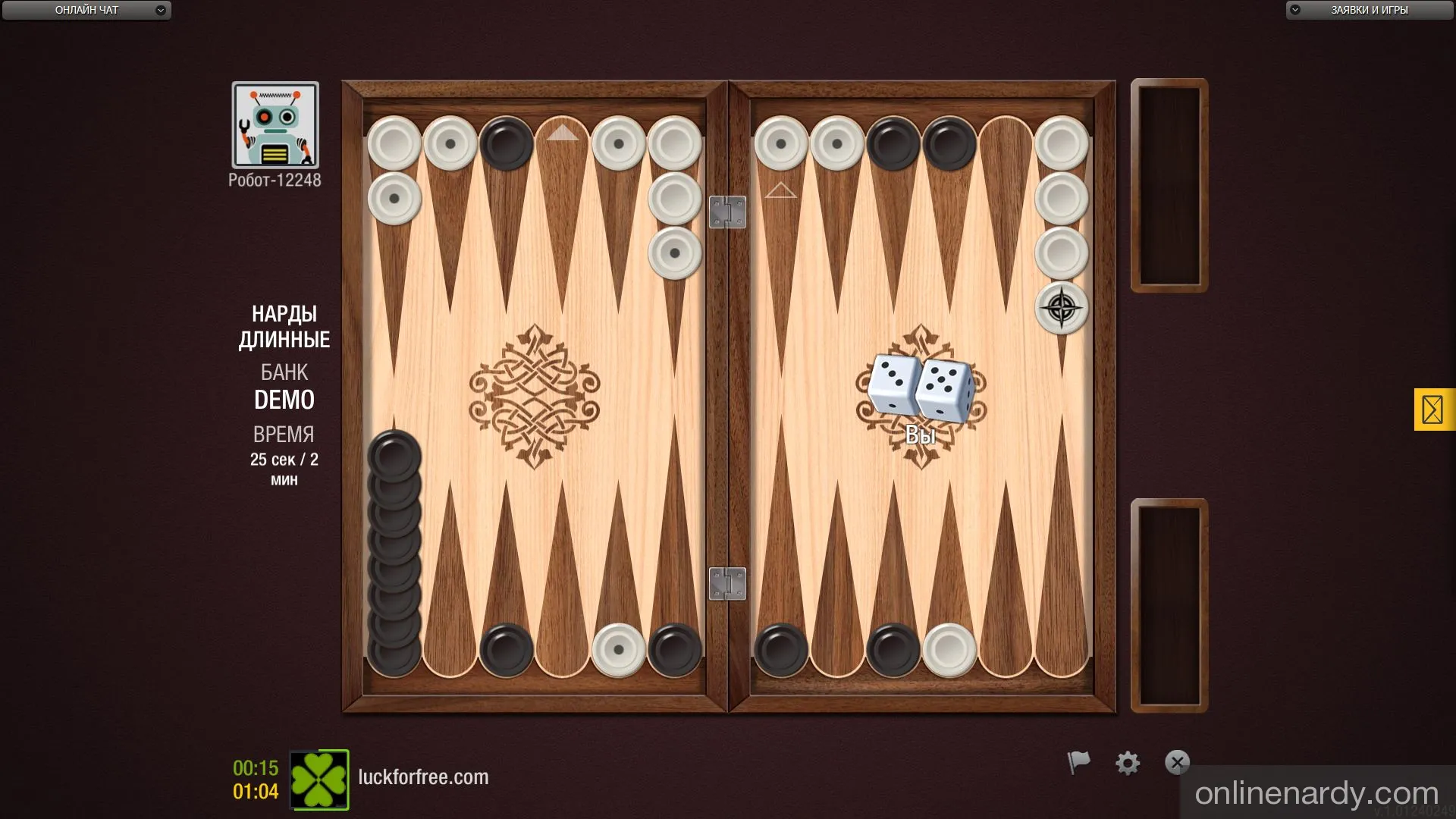
Defense and Closed Points
Two or more of a player's own checkers on one point close it to the opponent. Several such points in a row form a block and limit available moves. A complete chain of six closed points fully blocks the movement of an opposing checker caught in front of it.
Single checkers, on the other hand, are vulnerable to being hit. Therefore, when choosing a move, you need to consider not only the speed of advancement but also the risk of leaving a blot, as well as the opportunity to occupy points in your home board and make it harder for the opponent to return from the bar.
How to Bear Checkers Off the Board
Checkers may be borne off only after all 15 of a player's checkers have reached their home board. An exact die value allows a checker to be removed from the point with the corresponding number. Instead of bearing off, a regular move within the home board may be made if it complies with the rules of movement.
If there is no checker on the point indicated by the die, you must first check whether a regular move with a checker from a higher point is possible. A checker may be borne off from a lower point only when there are no own checkers on the indicated point or any higher points.
If one of the checkers is hit while bearing off, further removal stops. It must be returned from the bar, brought back into the home board, and only then can the remaining checkers continue to be borne off.
End of the Game: Oin, Mars, and Cox
A regular game ends when one opponent is the first to remove all 15 checkers from the board. The size of the loss depends on the losing player's checker position and the game-ending option selected when creating the game.
- Oin - the loser has borne off at least one checker; the base loss equals one stake.
- Mars - the loser has not borne off any checkers; the base loss equals two stakes.
- Cox - the loser has not borne off any checkers, and at least one of their checkers remains on the bar or in the opponent's home board; the base loss equals three stakes.
The "Oin" setting limits any loss to one stake. When "Mars" is selected, a regular Oin is worth one stake, while Mars and Cox are worth two. In "Cox" mode, all three levels apply: one, two, or three stakes respectively.
The "Resign" button ends the game early. In this case, the result type is determined by the actual position of the losing player's checkers at the moment of resignation and by the selected game-ending setting.
Draw Option
In the website settings, you can enable a draw with the right to the final roll. In this mode, the player who started the game second receives a final roll after the first player bears off their last checker. If the second participant also manages to bear off all their checkers with this roll, the game result is recorded as a draw.
Doubling Cube
The Doubling Cube allows the value of the current game to change during play. When creating a table, you can disable the cube or set its maximum value to 2, 4, 8, 16, 32, or 64. At the start of the game, its nominal value is 1, and the cube does not yet belong to either player.
A double may be offered only on your turn and before rolling the dice. On the first double, the opponent chooses one of two options:
- Pass (Drop) - decline the double and immediately concede defeat. The winner receives the result at the stake in effect before the double was offered.
- Accept (Take) - agree to the double. The cube value becomes 2, and ownership of it passes to the player who accepted.
After acceptance, only the cube owner may later offer a redouble. With each newly accepted double, the cube changes owners again, and its value rises successively to 4, 8, 16, and beyond, but not above the limit set in the game request.
Mars and Cox are counted together with the Doubling Cube. The final game multiplier is calculated by multiplying the ending multiplier (Oin = 1, Mars = 2, Cox = 3) by the current cube value. This rule also applies when a player voluntarily resigns. For example, Mars with a cube of 4 gives a total multiplier of 2 × 4.
For a player to accept a game request with an active Doubling Cube, their balance must cover the maximum possible loss. The minimum required amount is calculated as follows: table stake × selected Doubling Cube limit × multiplier of the selected game ending.
Standard and Caucasian Short Backgammon
The website offers standard and Caucasian variants. The main difference in Caucasian backgammon concerns hitting in your own home board: the checker with which a player hits an opponent's checker may not be hidden on the same turn by placing it on another of their own checkers. However, it is allowed to cover the hitting checker with another own checker in a separate move, continue moving it to an empty point, or, when the rules allow, bear it off the board.
Short backgammon combines racing, point blocking, and direct hits on single checkers. Knowing the order of entering from the bar, the requirement to play the dice, the bearing-off rules, and the possible game endings makes it easier to understand what is happening on the board and choose safe moves.